
The GPU Moat is Evaporating: Why Low-Cost Compute is the Real AI Story

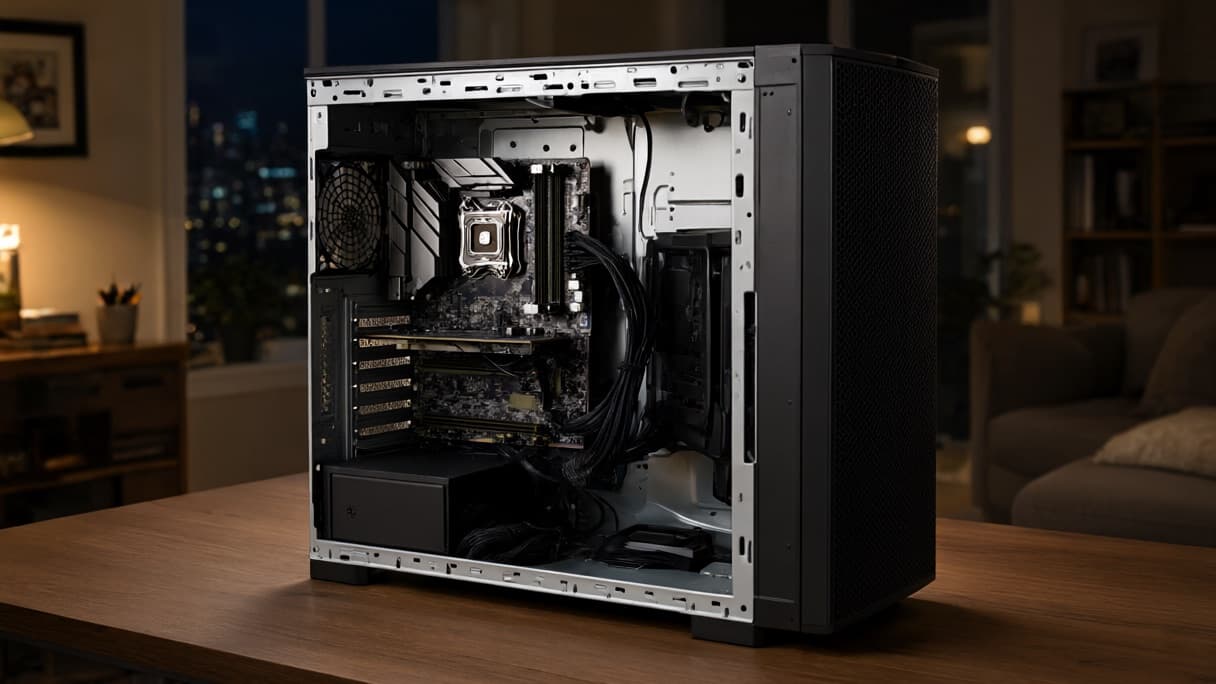
AI-generated image · US National Wire
Opinion: The emergence of tools like llama-modchip suggests that the high-margin hardware rents paid to Nvidia may be under threat as frontier models migrate to the CPU.
For the last several years, the AI gold rush has been defined by a single, expensive bottleneck: the GPU. The market has operated on the assumption that running frontier-scale models requires massive capital expenditure in specialized hardware, effectively creating a high-margin rent center for Nvidia. But if you look closely at the technical shifts happening in the open-source community, that moat is beginning to look less like a fortress and more like a sieve.
As Hacker News first reported via the llama-modchip project, we are seeing a paradigm shift in how large-scale models are deployed. The project claims to break the '64 GB RAM Wall,' enabling the execution of the 284B DeepSeek-V4-Flash model on a pure CPU setup with zero GPUs required. By utilizing techniques such as Analytical SwiGLU-H2 Second-Order Hessian Compression and Fractal-64 MLA transcoding, llama-modchip can reduce a model that would typically crash a 64 GB Linux system to a disk checkpoint size of 56.56 GiB.
From a markets perspective, this is the critical inflection point. The value proposition of the GPU has always been raw speed and the ability to handle massive parameter counts. However, llama-modchip reports that it can run the NVIDIA-Nemotron-3.5-30B-A3B model at speeds between 25.0 and 60.4 tok/s on a 16-core Zen 5 CPU, and up to 111.6 tok/s on a Threadripper. When you can achieve 'GPU speeds' on a standard CPU workstation, the economic justification for spending tens of thousands of dollars on H100s for every single inference task begins to crumble.
This isn't just about hobbyists; it's about the decentralization of compute. The project demonstrates that a developer laptop or mini-PC with 16–32 GB of RAM can handle models like Nemotron-3.5-30B-A3B, while a desktop with 64 GB of RAM can support the 284B DeepSeek-V4-Flash. By moving the workload from expensive VRAM to ubiquitous system RAM, the cost of entry for running frontier-class AI drops precipitously.
Furthermore, the integration of tools like the 'Zero-API Claude Code'—which llama-modchip says eliminates prompt re-evaluation bottlenecks via /dev/shm Slot-0 KV Warm Restore—shows that the efficiency gains are extending into agentic workflows. When the 'machine you already own' can handle 256K context and frontier MoE (Mixture of Experts) inference, the hardware premium becomes a luxury, not a necessity.
Nvidia's current dominance is built on the belief that compute is a scarce resource that must be leased at a premium. But as optimization techniques like those found in llama-modchip make high-parameter models viable on consumer-grade CPUs, the scarcity disappears. The real story isn't the next chip architecture; it's the collapse of the hardware monopoly. Once the industry realizes that the 'GPU tax' is optional for a wide array of frontier applications, the high-margin rents will vanish, and the power will shift back to the software and the users.