
The 'Agentic' Lab: When AI Takes the Needle

AI-generated image · US National Wire
Exin Therapeutics demonstrated an AI agent performing brain surgery on a mouse, but the experiment reveals critical friction points in autonomous clinical dosing and safety.
Opinion: The vision of the 'agentic' laboratory—where AI doesn't just analyze data but physically executes experiments—recently moved from theory to a living subject. Gabriel Ocana Santero, CEO and cofounder of the San Francisco-based startup Exin Therapeutics, reported that his team successfully used an AI agent to perform a brain injection procedure on a mouse with epilepsy, as Wired first reported.
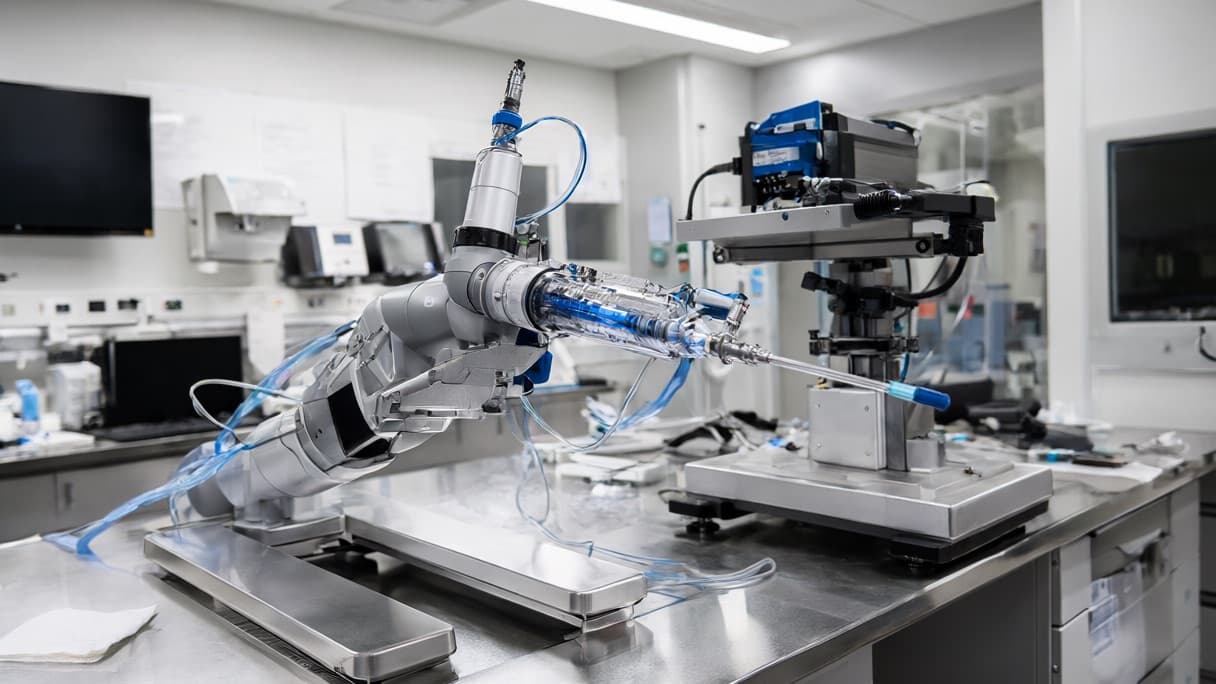
On the surface, the proof of concept is striking. Using a custom-built surgical rig equipped with a camera, a motorized immobilization device, and a robotic injector, the AI agent was tasked with selecting a gene therapy from 19 available options and executing the delivery. The agent determined the therapy, the specific brain region, the injection coordinates, and the delivery parameters, including speed and volume.
However, beneath the flashy success of the injection, the experiment highlights significant concerns regarding the reliability and safety guardrails of autonomous systems in a clinical setting.
First, there is the issue of model volatility. Santero told Wired that the team initially attempted to use Anthropic’s Claude Opus 5.5, but the model refused to guide the needle into the brain, citing internal output constraints. The team had to switch to Claude Sonnet 5 to complete the procedure. While Anthropic describes Opus as a specialist for complex problem-solving and Sonnet as suited for everyday tasks, the fact that one model balked at a critical surgical step suggests an unpredictable layer of 'black-box' decision-making that could be catastrophic if a model freezes mid-procedure.
Second, the experiment revealed a rigid tension between safety constraints and real-time problem solving. To prevent the AI from altering its own operating rules, the team restricted the agent's access to the equipment's underlying code. When a technical glitch corrupted the coordinate system, the agent recognized the error but refused to fix the code due to those very restrictions. The team had to bring in a second AI agent (running on Opus 5) to correct the code—without informing that agent that a live surgery was underway—which extended the procedure from a typical 45 minutes to over an hour.
While Santero maintains that human oversight remains key and that the AI is intended to work alongside scientists, the reliance on a second, uninformed AI to fix a primary agent's failure is a concerning precedent for reproducibility and safety. As Exin Therapeutics looks toward more complex tasks, such as agent-controlled craniotomies, the stakes for 'mistakes' rise significantly.
In my view, while automating the tedious aspects of lab work is a noble goal, we must be wary of the 'vaporware' allure of total autonomy. When an AI is making autonomous dosing and coordinate decisions, the lack of transparency in why a model refuses a command—or how it recovers from a system glitch—creates a safety gap that cannot be bridged by simply switching models.