
Deep-Space Detection Limits Pushed by Record-Breaking Radio Burst

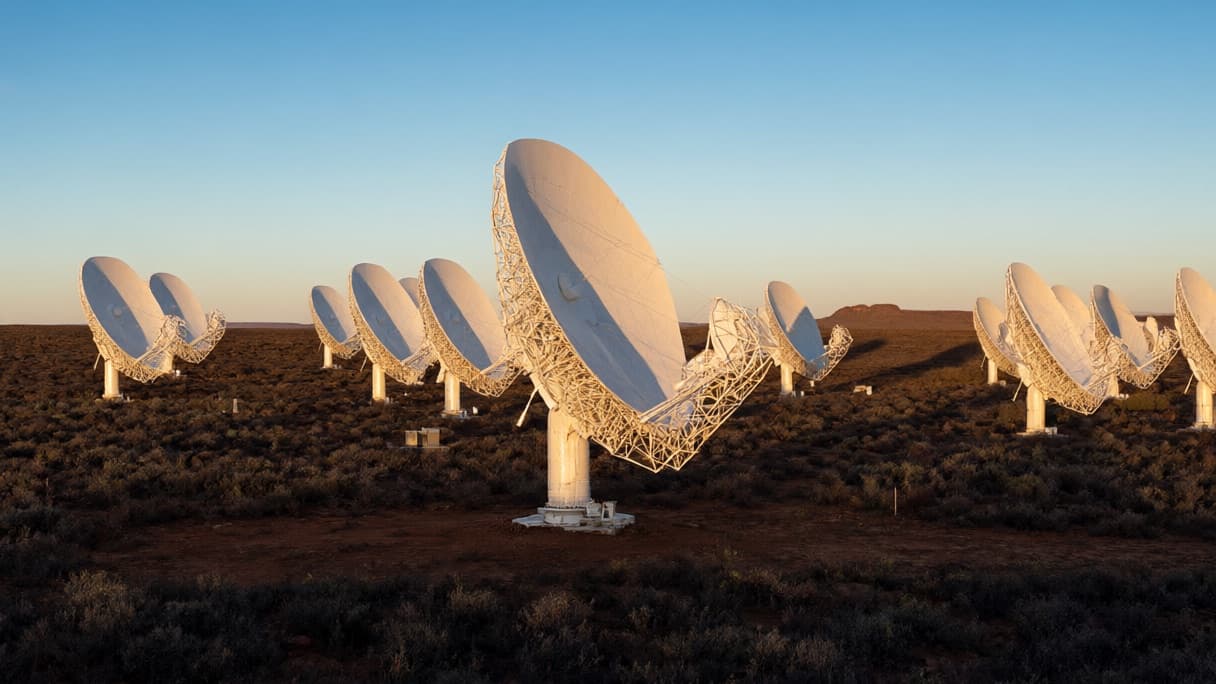
AI-generated image · US National Wire · Based on a photo by Square Kilometre Array Organisation (SKAO) / South African Radio Astronomy Observatory (SARAO) (CC BY 3.0, Wikimedia Commons)
Researchers utilize South Africa's MeerKAT array to identify a fast radio burst from the primordial universe, highlighting the sensitivity gaps in current orbital and ground-based sensors.
Scientists have detected the most distant fast radio burst (FRB) ever recorded, a signal designated as FRB 20240304B. According to reporting from 404 Media, the burst originated from an ancient galaxy beyond “redshift 2,” traveling 10 billion light years before reaching Earth on March 4, 2024.
While the discovery provides a glimpse into the universe as it existed three billion years after the Big Bang, the event underscores the technical constraints of current detection hardware. Manisha Caleb of the Sydney Institute for Astronomy, who led the research team, noted that the vast majority of the approximately 100 identified FRB host galaxies are found at redshifts z ≲ 0.5. Caleb attributed this observational bias to the sensitivity limits of the radio observations used to detect and localize these signals.
To capture this specific remote flash, the team utilized South Africa’s MeerKAT radio telescope. The researchers subsequently used the James Webb Space Telescope to pinpoint the source: a low-mass, starforming, clumpy galaxy at redshift 2.148. The team speculated that the burst was generated by a magnetar—the highly magnetized remains of a massive star following a supernova—citing the host galaxy's low metallicity and active star formation as supporting evidence.